
The Future of Cities: Designing for Uncertainty to Avoid Utopian Failure
The Rise of UrbanGPT and the Predictive City

A new era of AI-driven urbanism is unfolding in real-time. UrbanGPT, developed by Alpha Studio and Tim Fu, promises to revolutionize city planning by generating real-time urban designs, solving density challenges, and even conceptualizing entire cityscapes based on predictive modeling (Parametric Architecture, 2025).
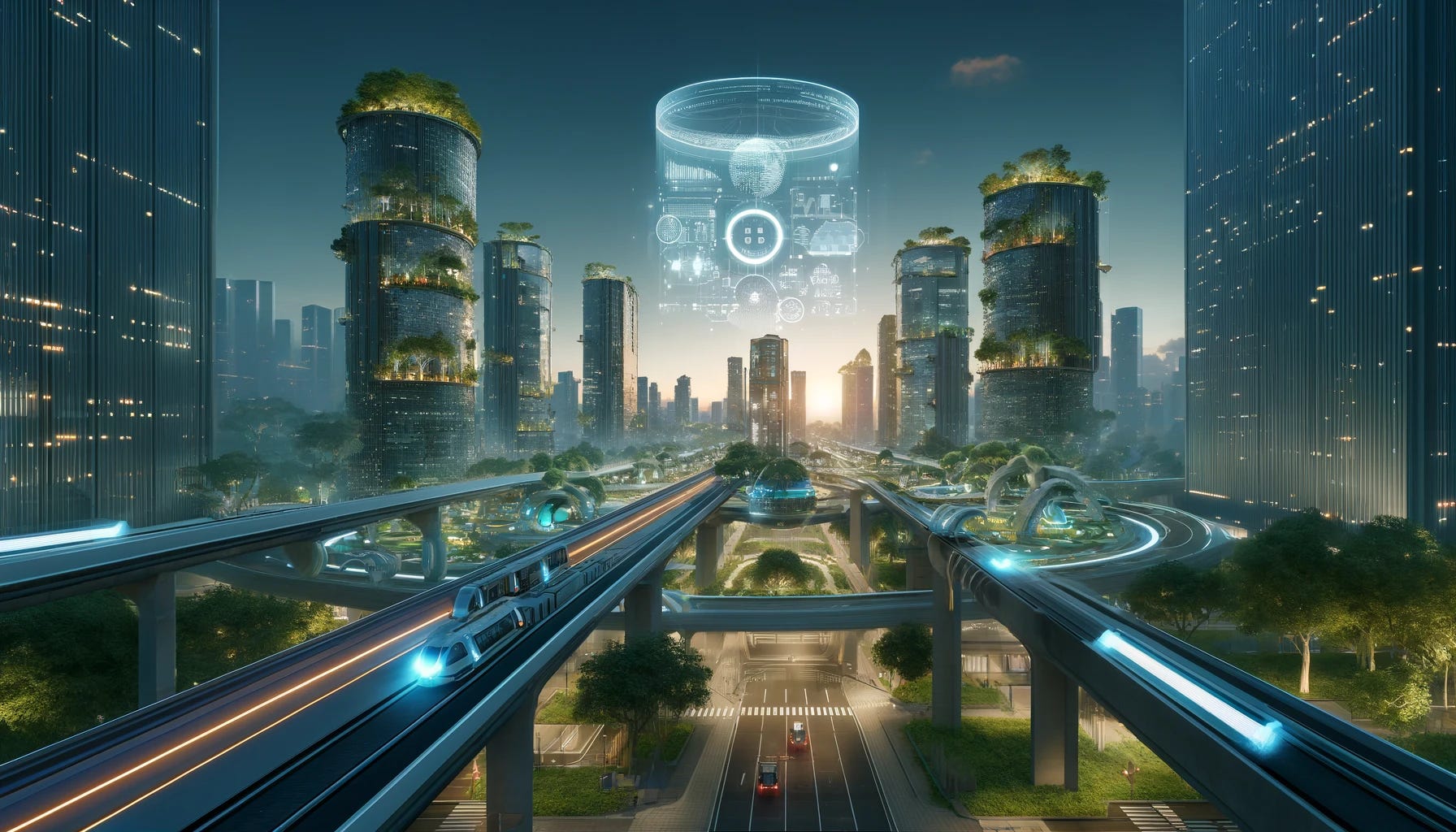
UrbanGPT generates sleek, high-density layouts in seconds, optimizing circulation, mixed-use efficiency, and sustainability metrics. But here’s the fundamental flaw: a city is not just a spatial equation—it’s a living system. AI can predict land use patterns, but it can’t anticipate human spontaneity. It doesn’t know where informal economies and street markets will emerge, how communities will repurpose dead spaces, embrace beloved graffiti street art, or where resistance to top-down planning will ignite. Worse, predictive models tend to reinforce historical urban biases rather than challenge them. They take the logic of failed master plans and automate them at scale. A city can be optimized into lifelessness.
The appeal is undeniable—an AI that can synthesize architectural principles, optimize land use, and generate adaptive urban solutions at an unprecedented speed.
But here’s the problem: we’ve been seduced by this kind of certainty before.
This isn’t an argument against city science, data analytics, or AI-driven urbanism. These tools are essential for understanding and synthesizing mobility patterns, climate impacts, and infrastructure resilience in ways human planners alone cannot. The ability to simulate urban growth, analyze transportation bottlenecks, and predict energy consumption is already transforming decision-making across global cities. The problem isn’t AI itself—it’s how we apply it. If predictive models are designed to eliminate uncertainty rather than work within it or celebrate it, they risk turning cities into static systems incapable of real-world adaptation.
For centuries, urbanists, architects, and policymakers have tried to design their way out of dysfunction, convinced that with better data, better tools, and better planning alone, they could eliminate the inefficiencies of organic growth. Haussmann’s Paris, Le Corbusier’s Chandigarh, Brasília, Songdo, Masdar City, NEOM, Toyota’s Woven City—each has promised to become the cutting edge of its time, promising a new kind of city optimized for the future. And yet, history has a way of proving that the perfect city on paper rarely survives first contact with reality.
Predictive urbanism suffers from the same blind spot as its predecessors: it assumes cities are stable enough to model, control, and perfect. They aren’t. Cities are shaped by human behavior, political shifts, economic disruptions, climate events, and cultural movements—the kinds of variables no AI can fully account for. If we’re not careful, the next generation of smart cities will repeat the same mistakes as the modernist utopias of the past: overdetermining outcomes, eliminating urban spontaneity, and designing systems that fail to evolve with the people who inhabit them.
Breaking the Cycle: Why We Keep Getting Smart Cities Wrong
At the heart of every failed urban utopia is an obsession with control.
Haussmann’s redesign of Paris (1853–1870) is often celebrated as the birth of modern urban planning, but it was also a tool of political suppression, aimed at making the city more governable, less resistant to power (Harvey, 2003). The grand boulevards? Designed just as much to prevent barricades as to promote commerce. It wasn’t about livability—it was about order.
The same logic played out in Brasília and Chandigarh, where modernist rationality replaced lived urban complexity. Brasília’s zoning system forced daily life into a car-dependent nightmare (Holston, 1989), while Chandigarh’s grid ignored the nuances of Indian street life, creating a city that felt sterile and disconnected (Prakash, 2002). Songdo, South Korea’s flagship smart city, built in the early 2000s, took this logic even further—automating waste disposal, embedding sensors into its infrastructure, and optimizing everything for efficiency (Townsend, 2013). The result? A city with world-class infrastructure and no soul. Predictability had replaced vitality.
Contrast this with Shenzhen, a city that was little more than a fishing village in the 1980s and has since grown into one of the world’s most dynamic urban economies—not because of a rigid master plan, but because of its ability to adapt. Shenzhen’s zoning laws evolved in response to industrial shifts, its tech districts emerged from organic innovation rather than government decree, and its housing grew through a chaotic mix of informal and formal structures.
Where Songdo attempted to preempt human behavior through predictive design, Shenzhen let its economy and culture shape the city’s form in real-time. The difference? One is struggling to attract residents, while the other is one of the fastest-growing megacities on the planet.
If Shenzhen embodies organic adaptability, Singapore demonstrates deliberate but flexible urban evolution. Unlike Songdo’s rigid, preemptive design, Singapore’s Urban Redevelopment Authority (URA) treats urbanism as an ongoing negotiation, updating zoning policies every five years to reflect economic and social shifts rather than locking land use into static assumptions.
The city integrates district cooling, automated congestion pricing, and dynamic land use adjustments, ensuring infrastructure evolves in real-time. Crucially, Singapore uses AI as a decision-support tool rather than an authoritarian planner—for example, its congestion pricing system adapts dynamically to actual traffic patterns rather than relying on pre-set, long-term predictions.
This is the distinction that must guide future urban AI applications: data-driven planning should enhance flexibility, not impose rigidity. AI should inform urban decisions—highlighting emerging patterns, offering multiple future scenarios, and revealing blind spots—but it must never assume it has solved the unpredictability of urban life.
The result? A city that is simultaneously one of the most planned and one of the most adaptable. Unlike Songdo, which assumes its AI-driven urban systems are perfect from inception, Singapore continuously refines its model, acknowledging that no predictive tool will ever fully capture the complexity of urban life. The lesson here is clear: smart cities must be allowed to fail and adapt, rather than assume they are built perfect from the start.
Copenhagen’s tactical urbanism offers another model of adaptability. Instead of rigid master planning, the city experiments with low-cost, temporary interventions that evolve into permanent solutions. The pedestrianization of Strøget in 1962—one of the world’s longest car-free streets—was initially met with skepticism but led to higher foot traffic and economic revitalization. More recently, Superkilen Park transformed an underutilized space into a vibrant, multicultural hub by incorporating design elements from over 60 countries, reflecting the district’s diverse population. These projects prove that urban success isn’t dictated by AI-driven optimization but by real-time, incremental adjustments shaped by people.
Now, with UrbanGPT and AI-driven city planning, we risk designing another wave of overly rational, overly controlled urban spaces that prioritize efficiency over humanity. If smart cities are to succeed, they cannot be engineered solely for optimization—they must be designed to embrace uncertainty, serendipity, and the messiness of human life.
The challenge is not whether AI and predictive analytics should be used in city planning—they absolutely should. The challenge is whether these tools can evolve beyond optimization and embrace uncertainty as a fundamental design principle. If city science continues to treat urban unpredictability as a flaw rather than a feature, we will keep designing overdetermined cities that break under real-world complexity. The future of city science isn’t in perfecting models—it’s in ensuring that those models are built to be questioned, iterated upon, and adapted in response to the unforeseen.
Some cities are already experimenting with AI-driven urbanism in a way that prioritizes adaptability rather than control. MIT’s City Science group has developed a dynamic urban simulation platform for Andorra, using real-time data to model multiple futures instead of prescribing a single deterministic outcome. By integrating agent-based simulations, mobility data, and urban heat mapping, Andorra’s city planners can explore different scenarios rather than relying on static predictions. The key here is not to remove uncertainty but to visualize it—to create tools that allow planners to respond dynamically rather than enforce rigid systems.
AI-driven tools like digital twins and agent-based models already allow planners to test multiple urban futures, but they must evolve to prioritize adaptability rather than optimization. Instead of treating predictive models as final answers, cities should use them to simulate uncertainty, anticipate emergent behaviors, and design for flexibility.
Multiverse Thinking: A New Model for Adaptive Urbanism
If predictive planning is fundamentally limited, how do we design cities that are adaptive, uncertain, forward-thinking, and resilient? The answer lies in multiverse thinking, a framework that moves beyond the false binary of order vs. chaos and toward a new model that encourages adaptive urbanism.
Cognitive Flexibility means designing cities not as fixed master plans but as living, evolving systems. This requires a shift away from rigid zoning, inflexible infrastructure, and static urban frameworks toward modular, reconfigurable environments that can adapt over time. Instead of predicting the future, cities must be built to accommodate multiple possible futures. UrbanGPT can be a useful tool here, but only if it generates divergent scenarios rather than reinforcing a single outcome.
Integrative Complexity challenges the simplistic narratives of smart cities. Too often, urban innovation is framed as a technological fix rather than a social, cultural, and political phenomenon. A city isn’t just a grid of mobility solutions or a seamless energy network—it’s an arena of conflict, negotiation, and cultural expression. Designing for complexity means allowing for contradictions, competing spatial claims, and emergent urban ecologies. It means seeing the city not as a machine but as a layered, overlapping system of human and non-human interactions.
Creative Synthesis is where true intelligence in urbanism can happen. The best cities aren’t rigidly designed—they emerge through synthesis, improvisation, and collision. Look at Tokyo’s urban fabric, where tight constraints and high density force constant reinvention. Look at medieval European cities, whose narrow streets and organic growth patterns created some of the most enduringly livable urban spaces in history. A truly intelligent city must leave room for serendipity, play, and experimentation—elements no AI system can predefine.
The challenge isn’t just conceptual—it’s governance, finance, and policy. How do you create a legal framework that allows a city to reconfigure itself in response to emergent conditions? How do you zone for flexibility rather than rigidity? How do urban finance models shift from fixed master plans to iterative, even uncertain future development, ensuring adaptability doesn’t collapse into chaos? Tokyo’s zoning laws, which allow for incremental, mixed-use evolution, offer one model, but few cities possess the political will or economic flexibility to follow suit.
One answer lies in alternative financing models. Instead of treating urban growth as a one-time capital expenditure, cities could fund development through adaptive financial mechanisms—such as land value capture, dynamic zoning incentives, and municipal bonds tied to performance metrics rather than static master plans. In other words, cities must not only be designed for change—they must be financed for it. Without this shift, the vision of a flexible, living city will remain a theoretical exercise rather than a real-world revolution.
The financial incentives of real estate development are also a major constraint. Most urban projects are designed for short-term returns, not long-term adaptability. Developers and policymakers must rethink how they fund urban growth—not as a one-time capital expenditure, but as an ongoing, iterative process of adaptation. Without this shift, the vision of a flexible, living city will remain just that—a vision.
Designing for Uncertainty: A New Approach to Future Cities
Urbanists must abandon the fantasy of total urban control. The best cities are not perfectly planned—they are perfectly adaptive. Instead of trying to design "the smartest city", we should be designing the most flexible, responsive, and open-ended urban environments possible.
To design for the future, we must abandon the illusion that cities can be controlled into perfection. The smartest city is not the one that predicts every outcome—it’s the one that can respond to change, reconfigure itself, and evolve in ways no master plan can foresee. AI can play a role, but as an exploratory tool, not an authoritarian script. Cities thrive when they allow for spontaneity, not when they overregulate it. Urban life will always be a negotiation between structure and serendipity, between data-driven logic and the unpredictability of human behavior. The goal isn’t to engineer the perfect city. It’s to build a city that can never be finished, never fully known—one that continues to surprise even those who designed it.
Cities don’t need to be smarter. They need to be wiser: more like the people who live in them—resilient, unpredictable, and always learning. The best cities aren’t finished; they are thinking. And wisdom comes from knowing that the future is always unfinished.
The best cities aren’t finished; they are thinking. The real question isn’t whether AI can predict the perfect city—it’s whether cities can become intelligent enough to outgrow their own predictions. If the next generation of cities is going to be adaptive, the next generation of urbanists must start designing for uncertainty now.
About the Author
Douglas Stuart McDaniel is an author, filmmaker, and global innovation veteran, specializing in digital urbanism, worldbuilding, and the future of cities. His career spans the nuclear, space, civil infrastructure, architecture, and urbanism arenas. His new book, Citizen One: Our Cities, Ourselves, and Our Uncertain Yet Extraordinary Future, will be published in September 2025 by Fast Company Press.
Bibliography
Batty, M. (2018). Inventing Future Cities. MIT Press.
Harvey, D. (2003). Paris, Capital of Modernity. Routledge.
Holston, J. (1989). The Modernist City: An Anthropological Critique of Brasília. University of Chicago Press.
Jacobs, J. (1961). The Death and Life of Great American Cities. Random House.
Prakash, V. (2002). Chandigarh’s Le Corbusier: The Struggle for Modernity in Postcolonial India. University of Washington Press.
Scott, J. C. (1998). Seeing Like a State: How Certain Schemes to Improve the Human Condition Have Failed. Yale University Press.
Shin, H. (2019). “Smart Cities, Sterile Spaces: Why Songdo Struggles to Thrive.” Journal of Urban Technology, 26(4), 15-34.
Townsend, A. (2013). Smart Cities: Big Data, Civic Hackers, and the Quest for a New Utopia. W.W. Norton.
Ülger, Sena. “Studio Tim Fu’s Urban-GPT-Alpha Transforms Text Prompts into 3D Urban Layouts.” Parametric Architecture, 2025.