

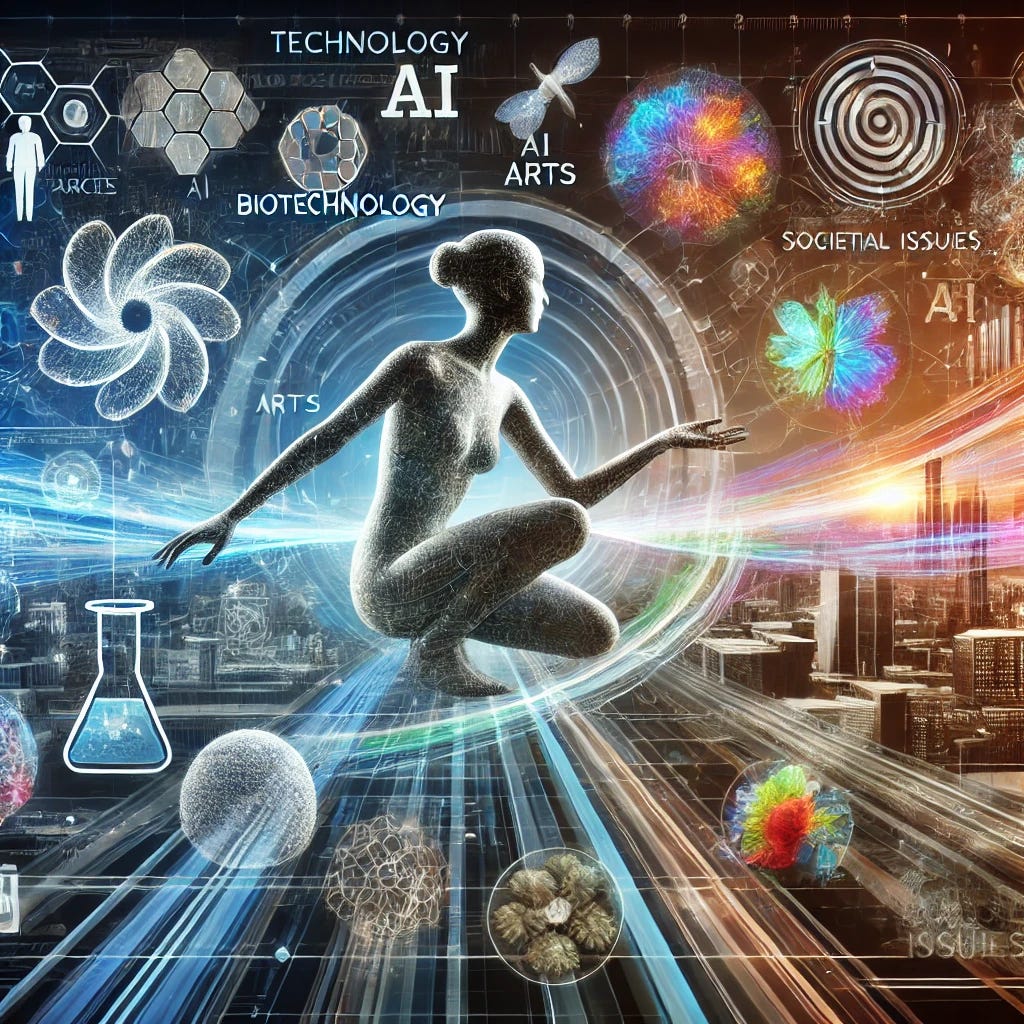
In the 21st century, “digital jacks of all trades” seem to have a greater knack for blending knowledge from various areas like technology, science, the arts, and societal issues. A contemporary, 21st-century polymath is essentially a jack-of-all-trades for the modern age, and that is a compliment, not an insult or a dig.
What sets them apart, more than just intelligence, is their curiosity and adaptability to new information and trends, such as AI, biotechnology, and the digital cultural shifts that continue to reshape our world.
"...for there is an upstart Crow, beautified with our feathers, that with his Tygers hart wrapt in a Players hyde, supposes he is as well able to bombast out a blanke verse as the best of you: and being an absolute Johannes fac totum, is in his owne conceit the onely Shake-scene in a countrey."
— Robert Greene, Greene's Groats-Worth of Witte (1592)
The phrase "jack of all trades, master of none" is often attributed to Robert Greene from his 1592 booklet, Greene's Groats-Worth of Witte. Greene coined the phrase “Johannes fac totu,” to criticize William Shakespeare, implying that Shakespeare was a mere actor who was presumptuously trying to write plays. How dare he? A “Shake-scene”, as Greene implied, refers to a self-important actor, who acts as a stage hog.
The full phrase, however, does imply that a person can often become competent in many skills, even if they may not be an expert in any particular one. Over time, the phrase has sometimes been used pejoratively to suggest a lack of deep expertise, though in my view and experience, it should indeed be seen as a compliment to one's versatility.
Their way of thinking could be likened to navigating a "multiverse"—a cognitive twist inspired by the concept in physics where many universes exist simultaneously. For such jacks of all trades—or polymaths, as some consider them—each field or discipline can be its own universe. Using an approach I like to call “multiverse thinking,” they are able to skillfully navigate and link these varied areas, creating connections that drive new ideas and solutions. They're adept at moving between such universes, drawing connections that might not be obvious at first glance.
One of their intriguing approaches to such thinking is often influenced by dialetheism, a philosophical idea suggesting that some statements can be both true and false simultaneously. This openness helps multiverse thinkers embrace complexity and contradiction, allowing them to navigate challenges and inconsistencies without being overwhelmed.

Multiverse thinking is characterized by the ability to operate across multiple domains of knowledge, integrating and synthesizing information to form new, innovative ideas. This mode of thinking allows individuals to draw parallels and make connections that are not readily apparent. It involves a depth of knowledge in various fields coupled with a breadth that can span the arts, sciences, and humanities. This approach to thinking is non-linear, highly associative, and creative, resembling the cognitive flexibility found in prolific inventors and thinkers.
Cognitive flexibility, a key component of multiverse thinking, involves the mental ability to switch between different concepts and to think about multiple concepts simultaneously. This is akin to a jazz musician improvising by blending various musical styles and instruments in real-time. Research on cognitive flexibility suggests that exposure to multiple disciplines can enhance this skill, leading to more creative outcomes in problem-solving (Scott Barry Kaufman, "Ungifted: Intelligence Redefined").
Integrative complexity is another aspect of multiverse thinking where a person can hold and understand multiple perspectives and integrate them into a coherent whole. This skill is crucial for addressing complex societal challenges that do not have straightforward solutions and require nuanced approaches.
Creative synthesis, the third critical facet of multiverse thinking, refers to the ability to combine knowledge from diverse fields to generate innovative solutions. This process is crucial in today's interdisciplinary and complex world, where single-discipline approaches are often insufficient to solve complex problems. By exploring how creative synthesis works and citing relevant research, we can understand how this concept facilitates groundbreaking innovations in various sectors.
Historically, figures like Leonardo da Vinci and Benjamin Franklin have embodied multiverse thinking with their wide-ranging contributions across various fields. Leonardo da Vinci, a polymath of the Renaissance, excelled not only as an artist, creating masterpieces such as the Mona Lisa and The Last Supper, but also as a scientist and inventor, devising concepts for machines like helicopters and submarines long before they were feasible. Benjamin Franklin was similarly versatile, known not only as a founding father but also as a scientist, inventor, and writer. He made significant contributions to the understanding of electricity and developed numerous public institutions, including libraries, schools, and hospitals.
In the contemporary world, individuals like Elon Musk and Mae Jemison continue to demonstrate this expansive approach. Elon Musk has made significant impacts in multiple industries, from automotive with Tesla Motors, to aerospace with SpaceX, and even neurotechnology with Neuralink. Mae Jemison, the first African American woman to travel in space, has also made significant strides in integrating science with social causes. She has worked in fields ranging from space exploration to global health and even led a project to improve healthcare in developing countries. Besides her notable achievements in science and space, Jemison has a strong connection to the arts, particularly dance and acting. She has been passionate about dance from a young age, studying various forms including African and modern dance. Her artistic interests even extended to her time at NASA, where she took a poster from the Alvin Ailey American Dance Theater into space during her historic space shuttle mission.
Furthermore, Jemison appeared on television in an episode of Star Trek: The Next Generation, making her the first real astronaut to appear on the show. This appearance highlighted her interest in blending science fiction with real-world scientific endeavors. Jemison's engagement with the arts reflects her belief in the importance of integrating creative and scientific thinking, which aligns with her advocacy for STEAM (Science, Technology, Engineering, Art, and Mathematics) education, promoting a more holistic approach to learning and problem-solving.
Tim Berners-Lee, inventor of the World Wide Web, has significantly influenced information technology, academia, and global communication. His invention laid the foundation for the modern internet, reshaping how we access and disseminate information. In the arts and technology, Björk, the Icelandic musician, consistently blends music, technology, and visual media to push artistic boundaries, using novel instruments and digital media to create new forms of art.
These examples highlight how multiverse thinking enables individuals to bridge diverse fields, fostering innovation that transcends traditional boundaries and catalyzes profound societal advancements. Multiverse thinking is particularly relevant in the 21st century due to the interconnected nature of global challenges such as climate change, public health, and technological disruption. This thinking style promotes innovative solutions that are informed by a confluence of different perspectives and disciplines. For instance, the development of green technology solutions often requires a combination of expertise in engineering, environmental science, policy, and economics.
In education, promoting multiverse thinking can be facilitated through interdisciplinary curriculums that encourage students to make connections between diverse fields. In the professional world, organizations can foster this kind of thinking by promoting diverse teams and creating environments that encourage cross-pollination of ideas.
Multiverse thinking encapsulates the mental agility necessary to thrive in the 21st century. As we face increasingly complex problems, the ability to navigate multiple intellectual landscapes will be crucial for innovation and progress. Encouraging the development of these skills through both educational reform and organizational practices could be key to unlocking the potential of future multiversers and, by extension, advancing human knowledge and solutions to global challenges.
In today’s fast-evolving job market, where AI and automation are reshaping roles and industries, embracing a “multiverse thinking” approach is more than just an intellectual exercise—it's a practical survival skill. This mindset, akin to navigating multiple universes of knowledge, equips individuals with the flexibility to adapt to new technologies and the shifting demands of the workplace. By cultivating curiosity and a willingness to explore diverse fields, everyday people can enhance their resilience against job displacement. This doesn’t mean becoming an expert in everything, but rather developing a broad understanding and the ability to connect seemingly unrelated dots. Embracing this approach enables anyone to stay relevant and competitive in an era of rapid innovation. It’s about being curious, staying informed, and ready to learn and re-learn—qualities that are essential for anyone aiming to thrive in the dynamic landscape of the 21st century.
To navigate these changes successfully, developing a 'multiverse thinking' mindset is crucial. This means moving beyond specialized or fixed ways of thinking to embrace a more flexible, interdisciplinary approach. Instead of viewing knowledge as confined within strict boundaries, multiverse thinking encourages exploring a wide array of disciplines and finding connections between them. This broader cognitive flexibility can lead to innovative solutions and new career pathways that might not be immediately obvious.
Here’s a hopeful perspective: anyone—in fact, everyone—not just the brainiacs, can cultivate this kind of thinking. It starts with fostering boundless curiosity about the world. Engage with topics outside your comfort zone, whether through reading, taking online courses, or participating in diverse forums and discussions. The key is to remain open and adaptable, qualities that are essential in a constantly changing world.
Moreover, embracing continuous learning and re-skilling can transform the anxiety of job displacement into an exploratory journey that could open doors to entirely new fields and opportunities. By broadening one’s cognitive skills and becoming more of a multiverse thinker, individuals are not just protecting themselves against the impacts of automation; they're also positioning themselves to lead and innovate in the future of work. This approach doesn't just safeguard one's career—it enriches personal growth and enhances the ability to contribute meaningfully to society in the face of unprecedented changes.